







INTERNATIONAL,JS- Buying a home in the United States involves more than a down payment and a monthly mortgage. Homeowners must also account for property taxes, which can add thousands of dollars to their annual housing expenses.
In 2026, Hawaii remains one of the least expensive states for property taxes as a percentage of owner-occupied home values. Meanwhile, New Jersey and Illinois rank among the states with the heaviest property tax burdens.
However, low tax rates do not always guarantee low housing costs. Home values, local assessments, exemptions, and special levies all influence the final amount that homeowners pay.
Recent changes in Los Angeles and New York City also highlight another important issue: luxury property owners may face additional taxes when they sell expensive real estate or maintain high-value homes as secondary residences.
How Do Property Taxes Work in the United States?
Property taxes represent a major source of funding for local governments across the United States.
For example, local governments rely on property tax revenue to finance public schools, police departments, fire protection, road maintenance, libraries, and other community services.
The federal government does not impose a nationwide annual property tax on homeowners. Instead, state laws establish the framework, while local taxing authorities generally determine the applicable rates and collect the revenue.
Although each jurisdiction follows its own rules, most property tax systems consider three main factors:
- Property value: The estimated value of the home or other real estate.
- Assessment rules: The method that determines the taxable value, including any applicable exemptions or assessment limits.
- Local tax rate: The combined rate that applies to the property within its taxing districts.
Homeowners should therefore check their local assessor’s records and tax bills rather than rely exclusively on statewide averages.
Property Tax Rates by State: Hawaii, New Jersey and Illinois
Statewide comparisons offer a useful starting point for people who want to estimate housing expenses before buying a home.
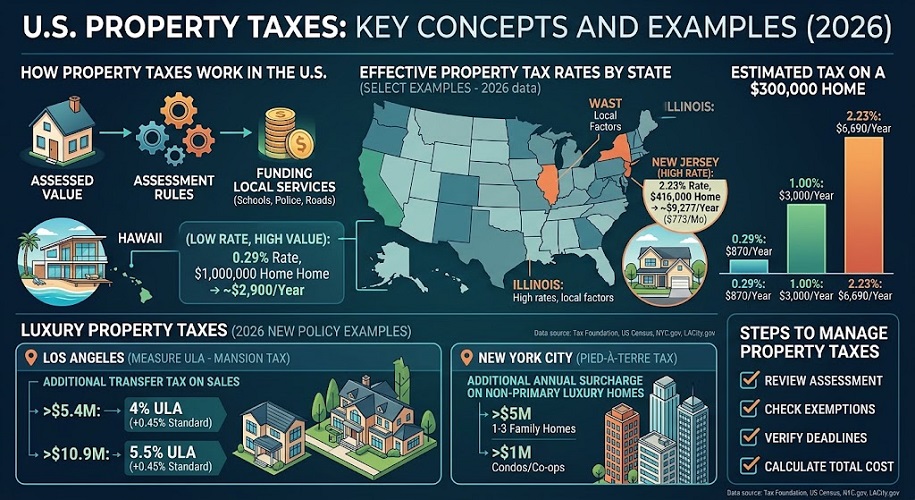
According to the Tax Foundation’s 2026 property tax data, which uses US Census Bureau housing data, Hawaii has an effective property tax rate of approximately 0.29% for owner-occupied homes. Alabama follows at approximately 0.37%.
At the other end of the spectrum, New Jersey and Illinois rank among the states with the highest effective property tax rates.
These figures measure property taxes paid relative to home values. They do not represent a universal rate that every homeowner in a state must pay. https://taxfoundation.org/data/all/state/property-taxes-by-state-county/
Hawaii: Low Rates Do Not Always Mean Cheap Housing
Hawaii offers one of the lowest effective property tax rates in the country. At approximately 0.29%, its rate can look attractive compared with those of high-tax states.
Nevertheless, prospective buyers must consider the state’s expensive housing market. A high-value home can generate a substantial annual tax bill even when the effective rate remains relatively low.
For instance, a hypothetical $1 million home with an effective property tax rate of 0.29% would generate approximately $2,900 in annual property taxes.
This calculation provides an illustration, not an actual tax quote. A property’s location, classification, exemptions, and local assessment rules can change the final amount.
New Jersey: High Annual Costs for Homeowners
New Jersey presents a different challenge. Its effective property tax rate ranks among the highest in the United States, making annual property taxes an important part of the household budget.
Consider a hypothetical home worth $416,000 with a 2.23% effective tax rate. The calculation produces an estimated annual bill of approximately $9,277.
That amount equals about $773 per month when divided across 12 months. Homeowners who pay through a mortgage escrow account may see these costs included in their monthly housing payments.
Actual bills vary by municipality, school district, property assessment, and available tax relief programs. Buyers should review the property’s recent tax bills before making an offer.
Illinois: Local Taxes Can Increase Housing Expenses
Illinois also has a comparatively high effective property tax rate. School funding, county levies, municipal services, and other local obligations contribute to the overall burden.
For buyers, the purchase price alone cannot provide a complete picture of affordability. A moderately priced home in a high-tax area can create a larger recurring expense than a more expensive property in a lower-tax jurisdiction.
Homeowners should compare the combined tax burden across nearby municipalities, especially when they consider relocating for work, education, or family reasons.
How Much Property Tax Will You Pay on a $300,000 Home?
A simple calculation can help prospective buyers estimate annual expenses.
The following examples apply hypothetical effective tax rates to a home worth $300,000. They illustrate how rates influence costs without predicting any particular property’s actual tax bill.
| Effective tax rate | Estimated annual tax | Monthly equivalent |
|---|---|---|
| 0.29% | $870 | $72.50 |
| 0.50% | $1,500 | $125 |
| 1.00% | $3,000 | $250 |
| 1.50% | $4,500 | $375 |
| 2.23% | $6,690 | $557.50 |
These figures exclude insurance, mortgage interest, maintenance, homeowners association fees, and other housing expenses.
Even so, the examples demonstrate why buyers should calculate property taxes before deciding how much they can afford to borrow.
Los Angeles Adjusts Its Luxury Property Transfer Tax in 2026
Los Angeles offers a separate example of how governments tax high-value real estate transactions.
The city’s Measure ULA, commonly known as the mansion tax, adds a transfer tax when a property sale exceeds specified price thresholds. Unlike annual property taxes, this levy applies when a transaction transfers real estate.
For transactions closing after June 30, 2026, the city uses updated thresholds of $5.4 million and $10.9 million.
Under the current schedule, sellers face an additional 4% ULA tax when a property’s transfer value exceeds $5.4 million but remains below $10.9 million. Transactions worth $10.9 million or more face an additional 5.5% ULA tax.
Los Angeles also charges its standard 0.45% real property transfer tax. Consequently, the combined rates reach 4.45% and 5.95% across the two applicable luxury price brackets.
The city directs Measure ULA revenue toward affordable housing and assistance for tenants facing homelessness. https://finance.lacity.gov/faq/measure-ula
These charges differ from annual property taxes, so buyers and sellers should not confuse the two when calculating real estate costs.
New York City Introduces an Additional Tax on Certain Luxury Second Homes
New York City has also introduced a new annual surcharge for certain expensive properties that do not serve as their owners’ primary residences.
The policy, commonly called the pied-à-terre tax, targets qualifying secondary residences, including certain houses, condominiums, and cooperative apartments.
New York’s 2026–2027 fiscal measures authorize the surcharge, which took effect on July 1, 2026. The rules cover qualifying one-, two-, and three-family homes valued at $5 million or more, as well as condominium and cooperative units valued at $1 million or more under the city’s assessment methodology.
However, the surcharge does not automatically apply to every expensive property. Primary-residence status, ownership circumstances, property classification, and the city’s eligibility rules can determine whether an owner qualifies for an exemption.
The city has also established procedures for property owners who receive notices and believe their properties qualify for an exemption.
This policy adds another cost consideration for investors and affluent buyers who own homes in New York City but maintain their primary residences elsewhere. https://www.nyc.gov/site/finance/property/non-primary-residence-surcharge.page
How Homeowners Can Reduce Their Property Tax Bills
Homeowners cannot always control local tax rates, but they can take several practical steps to manage their expenses.
First, review the property assessment. Compare the assessor’s valuation with recent sales of similar homes in the neighborhood. If the assessment contains an error or substantially exceeds the property’s supported market value, check the local appeal process.
Second, investigate available exemptions. Depending on the state and municipality, eligible homeowners may qualify for homestead exemptions, senior tax relief, disability-related relief, or other programs. Eligibility requirements differ across jurisdictions.
Third, verify tax deadlines. Local authorities may set different payment schedules, installment options, and penalties for late payments. Keeping track of these dates can help homeowners avoid unnecessary charges.
Fourth, calculate the complete cost of ownership. Before buying a property, combine estimated property taxes with mortgage payments, insurance, utilities, repairs, and other recurring expenses.
Finally, buyers should request recent tax bills and investigate whether a change in ownership could trigger a reassessment. A seller’s existing tax bill may not accurately predict the buyer’s future liability.
What Property Buyers Should Know in 2026
Property taxes remain one of the most important recurring expenses for American homeowners. Hawaii offers a low effective rate, while New Jersey and Illinois present heavier tax burdens relative to home values.
Meanwhile, Los Angeles applies additional taxes to certain high-value property transfers, and New York City imposes a new surcharge on qualifying luxury properties that do not serve as primary residences.
These differences show why buyers should evaluate local tax rules before committing to a mortgage or real estate investment.
The most reliable approach combines statewide comparisons with property-specific assessments, current tax bills, available exemptions, and local regulations. By examining all these factors, buyers can estimate their long-term housing expenses more accurately and make better-informed financial decisions.(*)