INTERNATONAL,JS- Canadian homebuyers have several mortgage options to consider in October 2026 as the latest interest rate environment shapes borrowing costs across the country. Borrowers who compare lenders carefully may find more competitive offers through independent mortgage brokers and specialized lenders than through the major Canadian banks.
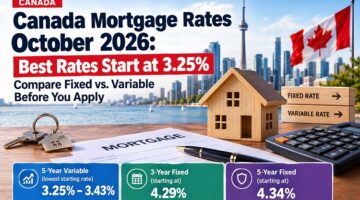
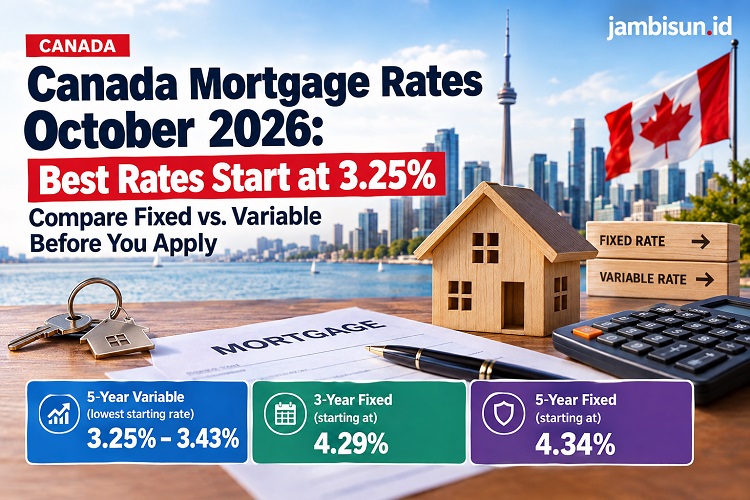
Current market figures place some of the lowest five-year variable mortgage rates around 3.25% to 3.43%. Meanwhile, selected three-year fixed mortgages start at approximately 4.29%, while five-year fixed options begin near 4.34%.
However, these figures represent advertised starting rates rather than guaranteed offers for every applicant.
Bank of Canada Rate and Prime Rate: What Borrowers Need to Know
The Bank of Canada’s overnight policy rate plays an important role in Canada’s mortgage market. It influences short-term borrowing costs and helps shape the interest rates that financial institutions offer their customers.
The prime rate matters particularly for homeowners who choose variable-rate mortgages. Many lenders calculate their variable mortgage rates using the prime rate as a reference, then apply a discount or premium according to the mortgage agreement.
For example, a lender might offer a variable mortgage at prime minus a specified percentage. If the prime rate changes, the mortgage interest rate may also change under the terms of that agreement.
Fixed mortgages work differently. Lenders generally consider government bond yields, funding costs, market expectations, and competition when setting fixed mortgage rates. Consequently, fixed mortgage rates do not necessarily move in lockstep with the Bank of Canada’s overnight rate.
Canada’s Lowest Mortgage Rates in October 2026
Borrowers should compare more than one mortgage term before selecting a lender. The lowest advertised rate may look attractive, but the right choice also depends on repayment flexibility, potential penalties, and the length of time a borrower expects to keep the mortgage.
The following figures reflect the market estimates supplied for this article. They should serve as comparison benchmarks, not confirmed live offers.
| Mortgage Type | Indicative Starting Rate |
|---|---|
| Five-year variable mortgage | 3.25%–3.43% |
| Three-year fixed mortgage | From 4.29% |
| Five-year fixed mortgage | From 4.34% |
These rates can help buyers establish an initial shortlist. However, applicants should request personalized quotes before comparing the total cost of competing mortgage products.
Five-Year Variable Mortgage: Lower Starting Costs, Greater Uncertainty
A five-year variable mortgage may appeal to borrowers who want a competitive initial rate and can manage possible interest rate changes.
When market conditions support lower variable rates, this option can offer an immediate cost advantage over some fixed-rate alternatives. Nevertheless, borrowers must consider the possibility that future rate increases could raise their interest expenses or monthly payments, depending on the lender’s payment structure.
A variable mortgage may suit buyers who maintain an emergency fund, have room in their monthly budget, and understand the risks of changing interest rates.
Three-Year Fixed Mortgage: A Balance Between Stability and Flexibility
A three-year fixed mortgage can offer a middle ground for buyers who want predictable interest costs without locking themselves into a five-year term.
With indicative starting rates around 4.29%, this option may appeal to homeowners who value payment stability but expect their financial circumstances to change within a few years.
For example, a buyer may anticipate moving to another city, selling a property, or reviewing their household budget before the end of a five-year period.
A shorter fixed term can provide an earlier opportunity to negotiate a new mortgage rate. However, borrowers should compare the initial interest rate, renewal conditions, and any penalties that could arise if they exit the mortgage early.
Five-Year Fixed Mortgage: Predictable Payments for Long-Term Planning
A five-year fixed mortgage may suit borrowers who prioritize stability and want to plan their household expenses with greater certainty.
The indicative starting rate of 4.34% gives buyers a reference point when comparing available offers. A fixed rate can protect borrowers from increases in market interest rates during the agreed term, although it may not deliver the lowest total borrowing cost in every market scenario.
Big Six Banks vs. Independent Mortgage Lenders
Canada’s major banks provide a wide range of mortgage products, but their advertised rates may differ considerably from the offers that independent brokers and specialized lenders can access.
The market estimates supplied for October 2026 illustrate this difference:
| Mortgage Product | Indicative Competitive Market Rate | Typical Major-Bank Posted Range |
|---|---|---|
| Five-year variable | 3.25%–3.43% | 3.95%–4.45% |
| Three-year fixed | From 4.29% | 4.49%–6.05% |
| Five-year fixed | From 4.34% | 4.89%–6.19% |
These ranges do not represent a like-for-like comparison of every available mortgage. A bank’s posted rate may differ from its negotiated rate, and a broker’s advertised offer may come with specific eligibility requirements.
Independent mortgage brokers can compare products from multiple participating lenders, including monoline lenders that specialize in mortgage financing rather than offering a full range of everyday banking services.
However, borrowers should not assume that every broker or alternative lender will offer the lowest rate. Some lenders charge higher fees, impose stricter conditions, or offer less attractive prepayment privileges.
Instead, compare the annual percentage rate where available, lender fees, prepayment options, portability rules, and the total cost over the period you expect to hold the mortgage.
Insured vs. Uninsured Mortgages: Why Your Down Payment Matters
Your down payment can influence the mortgage products and rates available to you.
In Canada, borrowers who make a down payment below 20% generally need mortgage default insurance when they meet the applicable requirements for an insured mortgage. Buyers who contribute at least 20% usually seek uninsured mortgage financing, although eligibility depends on the property, loan structure, and lender criteria.
Insured mortgages can sometimes qualify for lower interest rates because mortgage default insurance reduces the lender’s credit risk. Market estimates suggest a potential pricing advantage of roughly 10 to 25 basis points in some cases.
However, buyers must also account for the insurance premium. That cost can offset some of the interest savings, depending on the mortgage amount, down payment, and repayment period.
A buyer should therefore compare the overall borrowing cost rather than choosing a mortgage solely because it carries the lowest advertised interest rate.
Before applying, calculate the down payment, closing costs, emergency savings, and monthly housing expenses. A larger down payment may reduce borrowing costs, but buyers should avoid exhausting their savings simply to secure a slightly lower rate.
Canada’s Mortgage Stress Test: Can You Qualify?
A competitive advertised rate does not guarantee mortgage approval. Canadian lenders must assess whether applicants can manage their mortgage payments under the applicable qualification rules.
For many federally regulated lenders, the mortgage stress test generally requires applicants to qualify at the higher of the benchmark qualifying rate or their contractual mortgage rate plus two percentage points. Specific rules and exemptions can vary by mortgage type and lender.
For example, if a lender offers a contractual rate of 4.34%, the rate-plus-two calculation would produce a qualifying rate of 6.34%, assuming that figure exceeds the applicable benchmark.
Lenders also examine income, existing debt, credit history, property expenses, and other financial obligations.
Fixed Mortgage Penalties vs. Variable Mortgage Penalties
The cost of leaving a mortgage early deserves careful attention, especially for homeowners who expect to move or refinance before their term ends.
Variable-rate mortgages often carry a penalty equal to three months’ interest. However, borrowers should confirm the exact formula in their mortgage agreement because lender policies and product structures differ.
Consider a homeowner who plans to sell within two years. A mortgage with a slightly higher initial rate but more favorable exit conditions could prove more economical than a cheaper mortgage with a large early-termination penalty.
Before signing, ask the lender to explain the penalty formula in writing. Also, check whether the mortgage offers portability, which may allow you to transfer the existing mortgage to another eligible property under specified conditions.
How to Find a Competitive Mortgage Offer in Canada
Homebuyers can take several practical steps to compare mortgage offers more effectively.
First, request quotes from multiple banks, independent brokers, and specialized lenders. Compare offers for the same mortgage term, down payment, amortization period, and insurance status.
Second, look beyond the headline interest rate. Application fees, appraisal costs, legal expenses, prepayment privileges, and discharge fees can affect the overall cost.
Third, consider your plans for the property. A household that expects to remain in the same home for several years may prioritize stability, while a buyer who anticipates moving may place greater value on flexibility.
Fourth, calculate the monthly payment under different interest rate scenarios.
Finally, read the mortgage commitment and contract carefully. Confirm the interest rate, term, amortization period, payment schedule, prepayment privileges, and early-exit conditions before accepting an offer.
Conclusion: Which Canadian Mortgage Rate Should You Choose?
Canada’s mortgage market offers several options for borrowers in October 2026, with the supplied market estimates placing five-year variable rates around 3.25% to 3.43%, three-year fixed rates from 4.29%, and five-year fixed rates from 4.34%.
A variable mortgage may offer a lower initial rate, while a fixed mortgage can provide greater interest rate certainty during the agreed term. Neither option guarantees the lowest overall cost for every borrower.
The best decision depends on your income, down payment, risk tolerance, future plans, and ability to manage changing borrowing costs.
Editorial note: Mortgage rates change frequently. Verify all quoted rates and the Bank of Canada’s current policy rate against official announcements and lender offers before publication. The figures in this article are indicative market estimates, not guaranteed rates or individualized financial advice.(*)